Hail to the Chief (Justice)
This is a great day! Political Teen has the video of the swearing in of Chief Justice John Roberts.
This is a great day! Political Teen has the video of the swearing in of Chief Justice John Roberts.
Thomas Barnett has posted his excellent interview from Esquire with Def Secretary Donald Rumsfeld online. Check it out!
I take issue with those who say, because America wasn't prepared for a disaster on the scale of Katrina, this means we aren't ready for a terrorist attack. Can you imagine for an instant if a terrorist nuclear, biological, or chemical attack occurred on one of our major cities, the US Military wouldn't get instantly involved? Do you really think for a moment our President would wait until another disfunctional local government made up its mind to call in the troops, while the city burned? Please! Anyway, here's Strategypage on the downside of military disaster relief:
Thanks to U.S. taxpayers, DOD's material and communications capabilities are indeed unmatched. However, if federal "leadership" goes beyond providing communications and transport assets, it could stunt local and state emergency planning. Diminish local and state responsibility for immediate action, and overall response to the next mega-disaster may be far worse than the response to Katrina.


The last of the excellent Spruance class destroyers was decommissioned on September 21. The USS Cushing (DD-985) and her kin held the line toward the end of the Cold War and into the War on Terror. A great ship named after a great sailor!
Austin Bay on using the military for disaster relief:
LTG Honore has made a clever argument: Katrina struck like a very well-planned enemy attack. The storm knocked out communications, cut transportation routes, then surged in with a “rear attack” (breaking the levees after everyone thought the storm had by-passed New Orleans). This is an analogy that has some element of truth, and one that to a degree exculpates some of the decisions (or non-decisions) made at the local, state, and federal levels. Despite General Honore’s sound points about the storm’s surprise effects, I believe Governor Blanco proved to be an incompetent leader in the crisis. Why fiddle with the federal system because of a single state’s incompetence? Simplifying or stream-lining bureaucratic procedures in order to access useful DOD assets should interest all of us– we’ve already paid for the assets. Putting DOD in charge is another issue.
I'm inclined to agree with Austin, though Thomas Barnett makes a good argument:
Today, the military-market nexus is all about business continuity, whether we're talking local disasters, terrorist strikes or threats to the global economy. It's all about keeping business up and running. The warrior culture protects the merchant culture and the merchant culture funds the warrior culture, and the only standard that matters increasingly in our interconnected world is, "Can you keep the net up and running?" Whatever that net is...
Globalization needs more than just a bodyguard against bad actors bent on "direct action." It needs a system of System Administrators, and the military's got a big role to play in all this. Baghdad showed this. New Orleans showed this. Many other events in coming years will show this.
This ain't your daddy's military.
Then again, it ain't your daddy's global economy either.
This is great! Listen at Rush Limbaugh.com:
Who's heading out in the ditch down in Crawford
Speaking her mind that's lighter than air
Used by the left to capture the moment
Everyone knows it's Cindy
Who said the terrorists are freedom fighters
Who blamed the Jews for starting the war
Who's under wraps and won't answer questions
Everyone knows it's Cindy
Times-Picayune is reporingt grossly exagerated reports of death and mayhem in post Katrina New Orleans:
The picture that emerged was one of the impoverished, masses of flood victims resorting to utter depravity, randomly attacking each other, as well as the police trying to protect them and the rescue workers trying to save them. Nagin told Winfrey the crowd has descended to an "almost animalistic state."Four weeks after the storm, few of the widely reported atrocities have been backed with evidence. The piles of bodies never materialized, and soldiers, police officers and rescue personnel on the front lines say that although anarchy reigned at times and people suffered unimaginable indignities, most of the worst crimes reported at the time never happened.
and:
While the Convention Center saw plenty of mischief, including massive looting and isolated gunfire, and many inside cowered in fear, the hordes of evacuees for the most part did not resort to violence, as legend has it. "Everything was embellished, everything was exaggerated," said Deputy Police Superintendent Warren Riley. "If one guy said he saw six bodies, then another guy the same six, and another guy saw them - then that became 18."
Thanks to Instapundit for this.
Playing tonight on the Military Channel, Sept. 26 @10 PM EST.
A "routine mission" in Iraq on Sept. 4, 2004, turned into a raging firefight for Stryker troops with the 3rd Brigade, 2nd Infantry Division, Scout Platoon, and B Company of the 5th Battalion, 20th Infantry Regiment, as they fought off heavy fire (including 60-mm mortars and RPGs) in a rescue mission launched after Iraqi insurgents shot down a Kiowa helicopter and swarmed to capture it and the two pilots. Kiowa Down has all the action and drama of Black Hawk Down, but with a happy ending. The soldiers of 5-20 said this mission was the most intense fight they had encountered since being deployed in December 2003. B Company killed 66 enemies, and the Scout Platoon killed 46. (There were also 17 wounded.) The number of Americans killed in action: zero. There were only five U.S. wounded, in addition to the two pilots.
Also read this.
One of the recurring themes I noticed in yesterday's Pro-American, Pro-War on Terror rally in DC, was how the anti-war protestors are hurting America. Recalling the 1960's protests which humiliated our nation and brought about the first American military defeat in US history and it all makes sense. The America Legion recently produced Resolution 169, which adresses this fact:
Yet we also know from experience the impact that war protests can have
on troops in the fi eld. For instance, thousands of Americans demonstrated
against the Vietnam War, both here at home and overseas. Those who
branded Vietnam War veterans as “baby killers” may not have realized the
long-term impact and pain that their words would cause many veterans, not
to mention the short-term propaganda value that some of their antics would
provide the enemy.
In other words, the issue of how to voice dissent in a time of war is a complex
one. It’s complex because the members of the Legion family, like most
Americans, believe in freedom just as much as we believe in the men and
women who defend our freedom. As folk singer Bob Dylan once said, “I
think of a hero as someone who understands the degree of responsibility
that comes with his freedom.” Our troops understand this responsibility.
Antiwar groups began demonstrating against military action even before
U.S. troops began to strike back at our enemies. The antiwar group Act Now
to Stop War and End Racism actually held its fi rst antiwar rally on Sept. 29,
2001 – before U.S. forces began the liberation of Afghanistan, before the fi rst
terrorist was jailed at Guantanamo Bay, before the war in Iraq, even before
the fi res stopped smoldering in Manhattan.
Because of their methods, history will not judge these protesters kindly.
They are not only causing additional pain and anguish to America’s heroes,
they are also encouraging the enemy, thereby lengthening the war.
In our view, war is painful enough without adding anguish to its veterans
and their families. What do we mean by anguish? Walter Reed Medical Center,
where many of America’s injured warriors are being treated, has been
targeted by war protesters. Some demonstrators have gone as far as protesting
at funerals for America’s fallen heroes. Some opponents of the war have
even called the terrorists “freedom fi ghters.” These terrorists are people who
murder religious pilgrims, behead humanitarian aid workers, kill unarmed
U.N. offi cials and bomb U.S. troops as they rebuild broken cities. Simply put,
they are not freedom fi ghters. They are killers without conscience or compunction.
That was obvious to most Americans on 9/11, and it remains obvious
today.
22 The American Legion – Resolution No. 169
Indeed, one of the main reasons the Legion family has urged Americans to
support the war effort is the nature of the enemy and the nature of this war:
The War on Terrorism began in earnest only after the U.S. homeland was
attacked on Sept. 11, 2001. This undeniable fact makes the War on Terrorism
different from previous wars that drew protests inside the United States, such
as the Gulf War, the invasions of Panama and Grenada, the Vietnam War, or
the Korean War. Although each of these military actions was important to
the defense of America’s national interests, none of them came in response
to a direct assault on America’s homeland.
Another important difference between this war and earlier wars is the fact
that the men and women who are waging the War on Terrorism are all volunteers.
Not one soldier, sailor, airman, Marine or Coast Guardsman has
been drafted into this war. Although there can be little doubt that our troops
would rather be home than stay on the frontlines, no one can say that the
troops are serving against their will or being forced to fi ght.
No one in the Legion family wants to stifl e the right to public dissent; however,
it is fair to ask those who disagree with this war to do so responsibly.
Opponents of the War on Terrorism can voice their dissent in several ways
that are not harmful to the troops or helpful to America’s enemies. For example,
they can:
Run for political offi ce
Vote and campaign against candidates whose policies they fi nd objectionable
Write newspaper editorials and letters to the editor
Volunteer in election campaigns
Contact their representatives in Congress
This is the sort of dissent that is responsible in a time of war. It also happens to
be the sort of political action that has the most impact where it counts – with our
elected offi cials. Indeed, it’s important to note that a majority of U.S. citizens has
already expressed support for the War on Terrorism through the political process.
The War on Terrorism has been the central issue in one presidential election and
two congressional election cycles. Since we live under a representative system of
government, these elections have a signifi cant bearing on the nature and extent of
our nation’s involvement in this war.
Resolution 169, which clearly states The American Legion’s support for the War on
Terrorism, including U.S. military actions in Iraq and Afghanistan, is an effort to
support the majority of Americans as they support our troops.
As this states, the right to protest in war-time should be limited to the ballot box. Anything thing more will only harm our troops, and prolong the war.
This from the Korea Times:
The U.S. military conducted a simulation training exercise for a preemptive nuclear attack on North Korea in 1998, according to U.S. Air Force documents obtained by a ruling party lawmaker.
The declassified documents released by Rep. Choi Sung of the ruling Uri Party on Sunday also say that the U.S. deployed strategic nuclear weapons to a U.S. base in Chunchon, Kangwon Province, in 1987. Choi said he received the documents from the Nautilus Institute, a U.S.-based research group on Northeast Asian energy issues, which obtained the documents from the U.S. government through a Freedom of Information Act request.
and:
A squadron of 24 F-15E fighter jets belonging to the 4th Fighter Squadron of the 9th U.S. Air Force participated in the tactical training along with surveillance aircraft, tanker planes and air-to-air refueling tankers, according to a document named ``The History of the Fourth Combat Unit of U.S. Air Force: From January to June 1998.''
It says the F-15E aircraft from Seymour Johnson Air Force Base in North Carolina carried a BDU-38, a real-size model of the nuclear bomb B61, and dropped it on a training ground in Avon Park, Florida.
The "Korean lawmaker" goes on to blame "neocons", though Clinton could hardly be described as "neocon":
``The contents of these secret documents prove how hardliners in the U.S. government, dubbed ``Neocons,'' have prepared a preemptive strike against North Korea in a precise manner,'' Choi said.
Its official now. The President has set forth a new agenda for the US military as disaster relief, says the Washington Times:
"It is now clear that a challenge on this scale requires greater federal authority and a broader role for the armed forces -- the institution of our government most capable of massive logistical operations on a moment's notice," he said. That would require a change of law, since the Posse Comitatus Act of 1878 forbids the military from performing civilian law enforcement duties. Defense Secretary Donald H. Rumsfeld is investigating possible reforms to the act, which Pentagon officials consider archaic.
Though, this is being instigated by a conservative president, the real culprit is the liberal media, the very ones who so blatantly criticized the federal response. Failure to point to the incompetence of the locals mean the federals must now answer for the shortcomings of others. So much for State's Rights.
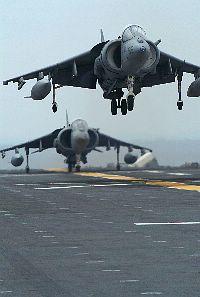
Starting tomorrow America's giant USS Nimitz will pit itself against India's tiny Viraat (formerly HMS Hermes) light carrier in naval manoeuvres in the Arabian Sea:
The eighth series of exercises, billed the most advanced so far, would not only see the pride of the US seventh fleet, Nimitz, in action, but also bring the carrier-based E2C Hawkeye Air Early Warning aircraft, the Los Angeles class submarines and the F-18/A hornet to Indian shores.
Against such formidable forces, the Indian Navy would pit its lone carrier, INS Viraat, carrier-based Sea Harriers, indigenously-built Delhi Class destroyer INS Mysore, Godavari class missile frigate and Shishukumar class submarines.
-Joshi said during the exercises, in which Indian Navy's ageing vertical take-off Sea Harriers jets would take on the far superior F-18 hornets, India would also field its Russian acquired TU-142m long-range maritime patrol aircraft as well as Seaking helicopters in both their roles - as anti-submarines and ferrying special marine forces.
A Soviet and British equipped military against the world's only superpower. Don't underestimate those Harriers either, like the Argies did!
Update: Here is another article on the war games, called Malabar 05, which goes into depth.
I'm a little concerned about this Congressional QDR committee which may use its power to keep unneeded and overpriced weapons. Listen to this from the Seapower Ambassador newsletter (I couldn't find the newsletter on their website):
One of the most critical programs involves funding for the next generation of destroyers, the DDX. Increasing the budget request for DDX is critical for both shipyards in the program to complete detailed design and move to production of the 21st century destroyer. Any delay in the program will result in major disruptions throughout the shipbuilding industry and the loss of thousands of critical job skills across the country.
and almost as an after thought they say it needed for defense:
Program delays will also increase risks to our national security as this ship is urgently needed to confront current and emerging threats.
Which makes me suspicious of their motives. Legacy weapons like the carrier, destroyers, and submarines will probably keep being built, but it may take another Pearl Harbor to convince Congress and the Navythe folly of relying on large platforms in the era of smart bombs and cruise missiles.

According to this update from CentCom. Only thing I found on my local paper was a critical article from the AP. This is good news, though:
“The election results will not be known for several weeks,” said Maj. Gen. Jason Kamiya, Commander of the Combined Joint Task Force 76. “However, we believe the real winners in this process are the people of Afghanistan who courageously took a stand against years of violence and oppression and took a major step forward toward peace and prosperity.”
“Let there be no doubt that the success of the National Assembly Election has strengthened the resolve and commitment of U.S. and Coalition Forces. We will relentlessly continue security operations, in partnership with Afghan National Security Forces, to keep the enemy on the defensive and to continue to bring security, reconstruction, and development to the Afghan people on behalf of their central government. ”
Woohoo!! President Bush is finally saying what we were all thinking, that the terrorist's became emboldened by lack of response of the Clinton administration. This is from NewsMax:
"The terrorists saw our response to the hostage crisis in Iran, the bombings in the Marine barracks in Lebanon, the first World Trade Center attack, the killing of American soldiers in Somalia, the destruction of two U.S. embassies in Africa and the attack on the USS Cole," Bush noted, after getting an update on the war on terror at the Pentagon.
"The terrorists concluded that we lacked the courage and character to defend ourselves and so they attacked us," the president added, in quotes picked up by United Press International.
Don't know what Slick Willy's up to, unless he's become Hillary's attack dog.
Updated Honest News, including these stories:
Never Leave a Fallen Comrade, Military Response to Hurricane Rita , Forces Pursue Terrorists, Aid to Tal Afar, Helping Iraq's Navy
In this commentary comparing Iraq and Vietnam, this article tells what we did wrong back then, and what we're doing right, now:
First, we took away their pride and sense of self-sufficiency and gave them the impression that we felt ourselves to be superior, generous entities who would solve their difficulties.Second, we failed to educate them for when they would have to take care of themselves. We failed to heed the old parable “Give a man a fish and he eats for one day. Teach him to fish and he eats for the rest of his life.”
The writer interviewed about 60 former Vietnam vets who currently are in Iraq:
11 are still in uniform -- three colonels, five lieutenant colonels, two master sergeants, and one warrant officer five.The others are federal employees or contractors. Their tours of duty in Iraq range from six months to more than 18. They are today, as they were in Vietnam, a diverse lot.
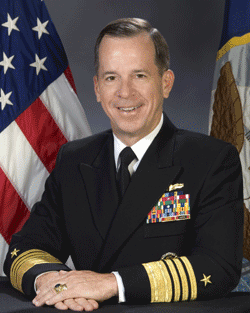
While discussing the need for more international cooperation in combatting terrorism and piracy at sea, new Navy chief Adm Mike Mullen had some choice words for the enemy:
They are wrong,” he said sharply. “They will not prevail. They will not succeed. Their message of despair and fear and hatred will, in the end, sway no one. Theirs is a small world of small-minded ideas. They offer nothing in return for the sacrifices they seek, not even the hope of hope itself.”
Here is the Admiral's bio.
So far, here is NORTHCOM's response to Hurricane Rita, even with ongoing relief efforts in the aftermath of Hurricane Katrina:
Defense Coordinating Officer and Defense Coordinating Element in Austin, Texas.
Five two-man communication teams, providing satellite phones and long-range satellite radio systems.
26 helicopters for damage assessment, search and rescue, and medical evacuation: 18 heavy-lift, six medium-lift and two medical evacuation helicopters.
USS Iwo Jima, USS Shreveport, USS Tortuga, USS Grapple, USNS Patuxent and USNS Comfort are preparing to follow the storm to the Texas coast.
Fort Sam Houston in San Antonio is designated as the operational staging area for distribution of supplies.
The 5th Army under Lt. Gen. Robert Clark is expected to be designated as a joint task force.
NORTHCOM's Joint Operations Center continues 24-hour operations to monitor the storm's progress and to facilitate subsequent requests for assistance that may come from FEMA representatives.
This review of Robert Kaplan's new book "Imperial Grunts" says there's more to our military than high tech weapons:
One of the more surprising of Mr. Kaplan's findings is that evangelical Christianity helped to transform the military in the 1980s, rescuing the Vietnam-era Army from drugs, alcohol and alienation. That reformation, together with the character-building demands of Balkans deployments of the 1990s (more important, in his judgment, than the frontal wars against Saddam Hussein), created our "imperial grunts."
and:
And in quiet moments the troops explain themselves in terms that call to mind an earlier America: God, country, honor, duty. "The clichés were spoken with utter seriousness," Mr. Kaplan assures us. "That's ultimately why these guys liked George W. Bush so much. . . . He spoke the way they did, with a lack of nuance, which they found estimable because their own tasks did not require it."
I'm for it! And so are these guys:
Instapundit
Truth Laid Bear
And check out the video at Political Teen.
(Sniff) I wan't a neat pig logo!
If the Washington Post is saying good things about the war in Iraq, it must be true!!!
The Tall Afar offensive, which began Sept. 2, is the largest urban military operation in Iraq since November's siege of Fallujah. Unlike many previous joint offensives, however, it is the Iraqi army that has the majority of the soldiers on the ground -- 5,000 of the roughly 8,500 troops involved -- that does the most intense fighting and that pays the heaviest price. At least nine Iraqi soldiers have been killed during the operation, compared with one American.
"We were not afraid. We are here to protect our country," said Pvt. Tarek Hazem, 28, of Baghdad
Like the President says "as the iraqi's stand up, we will stand down"!
This Strategypage article talks about the latest blog to replace Arthur Chrenkoff's Good News, which is no longer publishing. Good News Central will continue telling you what the media and the Left don't won't you to know about the War on Terror:
The site is covering the "good news" in both Iraq and Afghanistan, as a means of partially countering the "police blotter" style of reporting that usually dominates coverage of the war in both countries. This is comprehensive, covering the society, the economy, reconstruction, humanitarian aid, security, and the coalition forces. This has included, among other projects, a radio network in Afghanistan, updates on opinion polls from Iraq, and the start of construction work for eight new bridges in Iraq. This is a site that will receive some wide play on the internet, often from people who will want to know the rest of the story - a side of the story that is obscured. Other bloggers, like Michael Yon, have been providing coverage not seen in the media. Some of the military commands are also reaching out to the blogosphere as well, bypassing the legacy media.
Instapundit has more on this.
Update: Here is another article lauding the "Good News" pioneer Arthur Chrenkoff.
Strategypage discusses something I have already talked about here, that the US Navy is not so bad off in the number of ships, as many in the press and Congress (especially those in states that are shipbuilders) would like you to believe:
Today, the USN enjoys a "17 Navy standard"; that is, the total tonnage of Uncle Sam’s fleet is equal to the combined total tonnage of the next 17 smaller navies. Even combining the two biggest potential naval competitors (the Chinese and the Russians), the USN still outclasses them by over 3:1 in tonnage, and it has substantially more combat power. Of the world’s 34 aviation power projection platforms (i.e., vessels capable of operating combat aircraft), the US owns 24 (71-percent), eight times more than the second leading navy, the decidedly friendly Royal Navy, which has with three V/STOL carriers. In addition, the US surface fleet carries four times as many VLS (vertical missile launchers) cells as the rest of the world navies combined. The US submarine fleet enjoys better force ratios against the next two most numerous underwater fleets than it did against the Soviets during the Cold War.
Here you can also read more on this subject, my article "The Myth of the Weak Fleet".
This from Opinion Journal begs the question "what would the UN look like if we started over from scratch?"
Would we choose to start with an organizational chart anything like that of the U.N. today--a labyrinth so vast and secret that according to Mr. Volcker's findings even the U.N.'s own management cannot decipher it?
Would we start with a Secretariat like the one we have today, which has in some disturbing respects evolved into a sort of singularly privileged 192nd member state?...
Would we create a Security Council in which the despotic People's Republic of China holds a permanent seat and a fascist state such as Syria rotates through the presidency, but democratic Israel is systematically excluded from serving at all?
Would we create a General Assembly in which Zimbabwe, North Korea, Burma and Turkmenistan all wield a vote, but the elected leader of democratic Taiwan is not even allowed to set foot on the premises?
Would we create a U.N. in which the financial accounts are secret, the auditing is inadequate, and the standards are double or worse--lax for the highest officials and severe for lower-tier staff who lack patrons in the right places?
I'm probably one of a few conservatives for more gun control. After what went on in the Big easy, I'm reconsidering my position. Here's an article from Washington Times on this subject.
Residents organized armed patrols and checked on the elderly. They slept on their porches with loaded shotguns and bolted awake when intruders stumbled on the aluminum cans they had scattered on the sidewalk. Gunshots rang out for days, sometimes terrifyingly close. - A Texas woman who runs a Web site called Polimom.com served as a link between those who stayed and those who had left. With her help, they stockpiled an arsenal of shotguns, derringer pistols and an old AK-47 assault weapon. They were put to use the next day. "Some looters came up and pulled a gun on the wrong group of men," said Mr. Harris, adding that he did not fire a gun. He declined to say who else was involved in the battle. - "For five days, we didn't need FEMA [Federal Emergency Management Agency], the Red Cross or the National Guard," he said. "The neighborhood took care of itself."
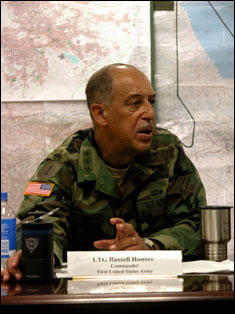
General Honore versus the media. I love this video! from Political Teen, and a transcript from Radioblogger
Also from Strategypage, a story on France's plan to join Operation Iraqi Freedom in 2002.
France would send 18,000 troops (about what they contributed in 1991) to join the Iraq invasion force. However, France wanted a specific area of occupation after the war, with full authority in that area for as long as Iraq needed to be occupied. The American State Department backed the French proposal, but the Department of Defense didn’t trust the French, and were suspicious of their motives. So the French officer went home empty handed, and the French government decided that invading Iraq was really an evil thing to do.
What exactly were the French up to? No one is sure, but the most plausible theory was that the French wanted to be in Iraq, after Saddam fell, to make sure no embarrassing documents, or witnesses, showed up. France had been supplying Saddam with weapons, and other assistance, for over three decades.
Anyone who doesn't understand why France, Germany, and Russia criticised the War, must have their head in the sand.
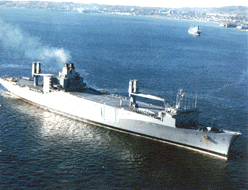
Strategypage says Norway is manning America's newest fast attack transports, the T-AKR class:
The Maersk Line, a Norfolk, Virginia ship management firm (owned by the Norwegian equivalent of the Social Security Administration), has won the contract to staff and run the U.S. Navy’s eight T-AKR class fast transports (Algol , Altair, , Antares, Bellatrix, Capella, Denebola, Pollux and Regulus). Maersk Line will get $3.25 million a year to provide a crew (42 sailors) for each ship, as well as maintenance and repairs.
Hopefully Norway won't protest our next war. This is from the Navy Fact File:
The Fast Sealift Ships are the fastest cargo ships in the world. The ships can travel at speed of up to 33 knots and are capable of sailing from the U.S. East Coast to Europe in just six days, and to the Persian Gulf via the Suez Canal in 18 days, thus ensuring rapid delivery of military equipment in a crisis. Combined, all eight Fast Sealift Ships can carry nearly all the equipment needed to outfit a full Army mechanized division.
Here is more on the "posse comitatus" debate. This paper defines the issues being raised including:
· Legal constraints
What would active duty troops be allowed to do in the event of another Katrina?
The Posse Comitatus Act passed in 1878 forbids federal troops from enforcing laws on domestic soil unless an insurrection is declared by the president.
Bush did not make clear whether he envisioned Pentagon troops helping with aid and rescue or with security duties as well.
· Political concerns
Who would decide when to send federal troops to a disaster? Bush suggested "federalizing" Louisiana's Guard forces when the chaos in New Orleans began escalating, but Gov. Kathleen Blanco objected to Washington taking control.
· Morale and training
Active-duty forces have performed admirably in the Katrina recovery, but this is not what they're trained to do. Troops in Iraq have often complained that they were not properly prepared for the neighborhood policing they have had to do.
Weren't there any neighborhoods in Iraq?
Updated Honest News:
Links to positive stories about America & the War on Terror. Updated regularly!
Want to find the funds to rebuild New Orleans. Start by cutting the defense budget! Listen to what Winslow T. Wheeler says the "rocket scientists" in Congress are doing:
With submarines today at $2.5 billion each, destroyers at $3.7 billion each and aircraft carriers at a breathtaking $13.7 billion, it's small wonder.
U.S. senators have come up with a response: Increase costs. You see, if the Navy competes the contract for its new DD(X) destroyer, analysts expect one of America's two remaining surface combatant shipyards will go out of business, probably the one in Maine.The defense bill now in the Senate will guarantee the Maine shipyard DD(X) contracts, and keep the competitor in Mississippi happy with guaranteed destroyer work as well. The Navy estimates the additional cost per ship at $300 million.
Thats my idea about cutting defense for Katrina, but letting go of DDX, much of JSF, and the Future Combat System (estimated $100 billion or more!) would pay for the whole business.
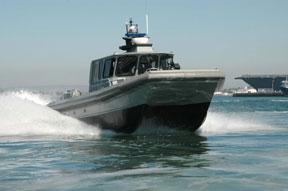
Or "Agile Cats" to be more precise. These new catamarans are being tested in San Diego and are geared to protect the big ships from another USS Cole incident. Says Navy Compass:
Commander, Navy Region Southwest Naval Boat Police (NBP), stood up after 9/11 as a maritime security force, recently upgraded its inventory with three new catamaran (cat) force protection boats.The three dual-hulled cats, manufactured by Moose Boats, and known by the company name, enable the NBP to perform missions more effectively than they could with their current SeaArk single-hulled boats.
and:
“These new boats are powered by twin 480-horsepower twin Cummings turbodiesels and have jet drive, so their handling is superb,” said Slater. “We can go from full speed (in excess of 38 knots) to full stop in less than a boat length (a bit more than 35 feet).”

The Corps of Engineers, while doing duty on the Gulf Coast, continues to rebuild Iraq, including this dam near Mosul. Says CentCom:
The largest dam in Iraq, Mosul earthen dam holds back upwards of 12 billion cubic meters of water for the arid western Ninewah Province while creating hydroelectric power for the 1.7 million residents of Mosul. This reconstruction project includes an upgrade of specialized maintenance equipment, seismic monitors, materials and spare parts. A training element is included with the aid package, which will help make the project self-sustaining in the future.
Wow, to think we can do a work this awe inspiring in the middle of a so called "quagmire"!
The Weekly Standard has a great story on the hypocrisy of liberals, who thought it was cool to go to war in Iraq, at least when Clinton was president.
I recall support being pretty widespread from the late 1990s through the spring of 2003, among Democrats and Republicans, liberals and conservatives, as well as neoconservatives. We all had the same information, and we got it from the same sources. I certainly never based my judgment on American intelligence, faulty or otherwise, much less the intelligence produced by the Bush administration before the war. I don't think anyone else did, either. I had formed my impressions during the 1990s and entirely on the basis of what I regarded as two fairly reliable sources: the U.N. weapons inspectors, led first by Rolf Ekeus and then by Richard Butler; and senior Clinton administration officials, especially President Clinton, Madeleine Albright, William Cohen, and Al Gore.

Col. HR McMaster leads the 3rd Armored Cav. Regiment in Iraq, recently in the epic battle of Tal Afar. Here's what the Washington Times had to say about McMaster:
Army Col. H.R. McMaster is a soldier-scholar who once advised Gen. John Abizaid, the top Middle Easter commander, on how to wage war in Iraq. Col. McMaster now is in the heat of that battle himself. For the past several weeks, he has led the campaign to retake the border town of Tal Afar.
Here is the Colonel's bio and here's the transcript of the press briefing on Operation Restoring Rights.
Please read my latest article at Opeds.com entitled "From Tragedy to Triumph", and thanks for your support!
In our private lives, or so it appears to be leading toward. During the Katrina disaster it became pretty obvious what was the only effective government agency on the ground. Here's what Bush called for in yesterday's speech:
It is now clear that a challenge on this scale requires greater federal authority and a broader role for the armed forces -- the institution of our government most capable of massive logistical operations on a moment's notice.
It's been coming for awhile, ever since Sept. 11. A while back I read this article in Parameters that is a fictional account of the military becoming more involved in non-military duties, with the consent of the people, finally taking complete charge of the government. Isn't this what happened to Rome?
I am calling my paper the "Origins of the American Military Coup of 2012." I think it's important to get the truth recorded before they rewrite history. If we're ever going to get our freedom back, we've got to understand how we got into this mess. People need to understand that the armed forces exist to support and defend government, not to be the government. Faced with intractable national problems on one hand, and an energetic and capable military on the other, it can be all too seductive to start viewing the military as a cost-effective solution. We made a terrible mistake when we allowed the armed forces to be diverted from their original purpose.
I've also written some fiction on a future military coup, called New Empires. You can read them here.Here's what the recently appointed House Homeland Security chairman Peter King had to say about press coverage of Hurricane Katrina, from NewsMax:
Asked why President Clinton wasn't blamed for natural disasters during the 1990s, King told WMET-Washington fill-in host Steve Malzberg: "The advantage the Clinton administration had was it didn't have so many TV reporters who were geared against the president that they would totally slant the news."
And on the local government response:
"I think the main fault was the state and city of New Orleans - they did a terrible job."
The New York Republican added: "Our response plans are based on the premise that the local first responders will handle the initial onslaught. We were't expecting that the local government would do absolutely nothing."

Thats what China's wants to do to America, according to this article:
Beijing is determined to annex Taiwan. But it is thwarted by the US. Faced with the US commitment to Taiwan, "China has stepped up its efforts to acquire two capabilities: a credible Taiwan invasion force and the capacity to sink American aircraft carriers should the US interfere militarily in the China-Taiwan issue."
This is something I've been warning for years, first in the Washington Post, and here also:
While struggling for shipbuilding funds, the Navy still insists on purchasing the new CVN-21 for $11 billion dollars. This doesn't include the cost of missile escorts or naval aircraft.
At the same time, according to the Cato Institute, diesel subs, naval mines, and cruise missiles are pushing aircraft carriers further out to sea. Russia has a new torpedo called the Shkval, capable of 300 knots, which, in the hands of North Korea or Iran, could split a carrier in two before her captain could sound a warning.
Opinion Journal says the welfare state failed New Orlean's poor long before Katrina:
This isn't a failure of President Bush's compassionate conservatism. Nor is it evidence that Ronald Reagan's philosophy of smaller government is fatally flawed. If LBJ had won his war on poverty, Ninth Ward residents would have had the means to drive themselves out of New Orleans. Instead, after decades and billions of tax dollars have been poured into big government programs, one out of four people in the Big Easy were still poor. That is an indictment of the welfare state and all its antipoverty programs.
Being poor isn't necessarily a bad thing, as some would have you believe. What's worse is being poor in spirit.
Members of Congress are calling for an independent review of the nation's defenses, claiming the Pentagon's upcoming Quadrennial Defense Review is "budget driven", rather than what's needed to fight the War on Terror. From Defense News:
Rep. Duncan Hunter, R-Calif., said he will order a study of the long-term threats to U.S. national security, and from that determine the weapons and manpower needs of the military. Hunter insisted he does not want a review based on what the Department of Defense thinks we can afford, but on what we need.
The review, to be conducted by committee members and staffers, is to serve as a counterweight to the Pentagon's Quadrennial Defense Review (QDR). The QDR is expected to help shape military strategy and force size, and could seal the fate of weapons such as the F/A-22 stealth fighter and the DD(X) destroyer.
But Hunter and others on the House Armed Services Committee worry that the Pentagon review will be too heavily influenced by questionaffordableility.
Personally, I think that cost has everything to do with "what we need". If the weapons we need cannot be afforded in appropriate numbers to defend ourselves, what good are they. If Congress wants to continue funding legacy weapons, let them purchase tried and true platforms like F-16s, or M-1 Abram's tank. At the rate we're going with DDX and the Raptor, only a handful can be bought, while potential enemies like China deploy huge numbers of cheap but capable ships and fighters.
Thanks to Daily Intel Briefing for this!
With all the constant deluge of bad news coming from all points, I've been fulfilling a dream of mine and posting positive stories on a sight I dub Honest News. Please check it out regularly. I'll also post the link on this page, and thanks for your support!!
Here's another update on the ongoing military support for victims of Hurrican Katrina, from the DoD:
72,614 troops - 22,439 of them active duty, 45,871 National Guard and 1,895 reserves - are serving on the ground or aboard ships in the region;
19 U.S. Navy ships are in the area;
346 helicopters and 68 airplanes are supporting the operation;
259 sorties were flown during the past 24 hours, bringing the total to date to more than 12,000;
2,037 DoD medical personnel are serving in the area;
7 installations are serving as transportation staging areas for ice, water, food and medical supplies;
16.7 million meals, ready to eat have been delivered, with 1 million of them diverted to Virginia and Georgia to support Hurricane Ophelia response, if required;
789 beds are available in field hospitals at Louis Armstrong New Orleans International Airport, the 14th Combat Support Hospital, and aboard USS Bataan, USS Iwo Jima and USS Shreveport;
119 nations and 12 international organizations have offered assistance, with Little Rock Air Force Base, Ark., serving as the central collection point for supplies donated by foreign countries;
19,056 cubic square feet of water is being pumped out of Louisiana's New Orleans and Plaquemines parishes by the Army Corps of Engineers as part of Task Force Unwater;
12 interim repairs have been completed on New Orleans' levee system, with Army Corps of Engineers identifying a total of 27 levee breaches, 19 of them attributable to Hurricane Katrina; and
390,487 cubic yards of debris, of the estimated 77.5 million cubic yards that require moving, have been removed by the Army Corps of Engineers.
The military saved the day in Lousiana, while civilian leadership floundred according to this story from the Toronto Star:
It looks like the military is the only thing that's functioned in this entire mess," Michael Greve, an expert in governance at the American Enterprise Institute, told the Christian Science Monitor. "Once they arrived, things turned around."
While civilian relief agencies will play a greater role as the situation stabilizes, we seem to be witnessing another example of the "militarization of humanitarian relief," a term used by foreign policy pundit Robert Kaplan in an interview with the Star's Lynda Hurst last week.
and:
The politicians were no better at providing leadership. Louisiana Governor Kathleen Blanco was almost invisible, Mayor Nagin colourful but ineffective — his police force just melted — and the president strangely disengaged and rhetorically inept.
The American military, however, is used to solving problems. Whatever political difficulties still exist in Iraq and Afghanistan, there is no denying the brilliant military victories the Americans won in both those countries, nor the pivotal role U.S. forces played in the tsunami relief effort.
The Minister in charge of Indonesian Tsunami relief has some words to say to those who criticize America's response to Hurricane Katrina:
"Any country in the first two weeks, they are always criticized," said Alwi Shihab, who took charge of the aid operation three days after the waves hit Aceh province on Dec. 26, killing a staggering 130,000 people and leaving 500,000 more homeless in Indonesia.
"The first 10 days we were cursed for being sluggish. If the government satisfies half the people, the other half will complain. And this one half will be heard by the world," Alwi, a respected former foreign minister, said in an interview with The Associated Press.
He goes on to describe the different reactions from the population of Indonesia and New Orleans:
Unlike in New Orleans, where law and order broke down soon after the levees broke, there was little or no looting in Aceh - something most people attribute to the region's strong community ties. Aid officials also were impressed by the self-sufficiency of the Acehnese.
"The reality is that people picked themselves up very quickly," said John Long, an Irish aid worker who has been in Aceh since soon after the disaster.

At least this is what outgoing Air force Chief John Jumper is saying:
U.S. Air Force Chief of Staff Gen. John Jumper on Monday said arguments for restoring some Lockheed Martin Corp. F/A-22 fighter jets cut from the Pentagon's 2006 budget were "making sense" to military planners.
"Quite frankly, I don't think the number's going to stay the same. I think we're making good arguments for why we need this airplane," Jumper told reporters at a final roundtable before he hands over the reins as the Air Force's top uniformed officer to Gen. Michael Moseley on Friday.
"The capability, I don't think, is being questioned any more, just the size" of the order, Jumper said, when asked about the F/A-22's fate in a once-every-four-years review of defense programs under way at the Pentagon. "I think our arguments are making sense."
Actually, I believe this is wishful thinking on the part of Gen Jumper, the last of the "fighter mafia", who cling to their manned fighters like Curtis Lemay to his bombers. Its a new war general, get used to it.
With the Federal Border Patrol stretched thin after the Hurricane, volunteers from the Minuteman Civil Defense Corps are stepping in to fill in the gaps, says the Washington Times:
"Border Patrol agents are in the area affected by Katrina to provide security and law-enforcement support," said Minuteman founder Chris Simcox. "This shift in personnel away from the border to New Orleans and other affected areas leaves our country vulnerable to increased trafficking by illegal aliens and terrorists attempting to enter the United States."
Mr. Simcox, publisher of a Tombstone, Ariz., newspaper, said Minuteman civilian volunteers -- as part of an operation known as "Secure Our Borders" -- have been deployed "to fill gaps in border security as U.S. Border Patrol agents are reassigned to disaster-relief duty."
Thank God for the Volunteers! Everyday citizens working without pay are increasingly seen as more effective than the vast federal bureaucracy. Here is their website.

In every crisis a hero is born. America has found one in Gen Rusel Honore, leading Army relief efforts in New Orleans. This story from the Washington Post says he's even won over the city's mayor, among others:
Honore has won over even some of the government's harshest critics, including New Orleans Mayor Ray Nagin, who blasted the Bush administration's initial response to his city's disaster.
"He came off the doggone chopper, and he started cussing, and people started moving," Nagin told a radio station. "I give the president some credit on this. He sent one John Wayne dude down here that can get some stuff done."
and:
"He's intolerant of lackluster performance," said Retired Gen. Charles E. Wilhelm. "He has high standards and he's a sworn enemy of mediocrity."
Here is a list of ongoing military operations in regard to the Hurricane Katrina relief, from the DoD:
20 U.S. Navy ships remain in the area;
346 active-duty and National Guard helicopters and 68 airplanes are providing aviation support in the area;
274 sorties have flown in the past 24 hours supporting the operation, bringing the total to date to 11,669;
Seven installations are providing support as transportation staging areas for ice, water, food and medical supplies;
16.7 million packaged meals have been delivered, with 1 million of them diverted to Virginia and Georgia to support Hurricane Ophelia response, if required;
789 beds are available in field hospitals at Louis Armstrong New Orleans International Airport, the 14th Combat Support Hospital, and aboard USS Bataan, USS Iwo Jima, USS Tortuga and USS Shreveport; and
115 nations and 12 international organizations have offered assistance, and Little Rock Air Force Base, Ark., is serving as the central collection point for supplies donated by foreign countries.
In addition, the Air Force is sending 2 C-130 Hercules aircraft especially modified to spray "skeeters":
In another new development, two C-130 Hercules aircraft from the Air Force Reserve's 910th Airlift Wing are preparing begin the first mosquito-spraying missions in the region today. The initial focus will be the New Orleans area, then outlying areas of Louisiana and Mississippi, if required, officials said.
The wing, from Youngstown, Ohio, is deployed to Duke Field, Fla., to carry out the mission

Strategypage says the Army is going ahead with transforming its heavy Cold War divisions into lighter Brigade Combat teams, more relevent to the War on Terror. Armed with advanced precision weaponry, these will still have the fighting power of the larger formations, but with greater mobility. Here are the planned locations of the new brigades:

The naval base at Guam is getting a big boost in the next few years, thanks to Donald Rumsfeld's ongoing transformation of the military. Stars & Stripes says in addition to the attack subs already based there, an Ohio class cruise missile submarine is on the way:
Rear Adm. David Gove, who heads Submarine Group 7 and commander task forces 74 and 54 out of Yokosuka, also lauded the “incredible individuals” who’ve propped up Guam’s burgeoning naval hub and said it might receive a guided-missile submarine in future to boost the two nuclear-powered attack vessels now assigned there.
With the ability to load 154 Tomamahawk missiles, as well as Navy SEALs, these SSGN's are the new battleships, likened to the Iowa's in the 1980's, also a very sucessful conversion.
While many are blaming the federal government for much of what went wrong after Hurricane Katrina, at least some are faulting local leadership. Mounting evidence is showing that the Mayor of New Orleans failed to inact his own disaster plans:
"Mayor Nagin has blamed everyone else except himself," said the Rev. Jesse Lee Peterson, founder and president of the Brotherhood Organization of a New Destiny. "The mayor failed in his duty to evacuate and protect the people of New Orleans. ... The truth is, black people died not because of President Bush or racism, they died because of their unhealthy dependence on the government and the incompetence of Mayor Ray Nagin and Governor Kathleen Blanco," he said.
Austin Bay says the chain of command for disaster relief is first local, then state, and finally federal. I concur! also on Kofi Anan , Saddam's confession , and Sandy Berger's slap on the wrist.
Thomas Barnett says its Stupid to be Afraid and on the Iraq-Vietnam analogy.
Fourth Rail discusses the alledged capture of an Iraqi town by insurgents and the Battle of Tal Afar
Michelle Malkin on Air America
Murdoc on finger pointing and relieved FEMA chief Michael Brown.
Blogs for Bush on "The Flight That Fought Back"
Mudville says Iraqi Soldiers Donate to Katrina Victims and on the Man Who Predicted 9/11

Strategypage says the US Military is building a network of forst in Iraq to stop insurgents from crossing the borders:
The American plan is a series of 300 fortified bases or forts, and a force of 32,000 new border guard troops. At the moment, there are only 12,000 people in the border force, and only about half the forts and bases are completed, or under construction.Many of the border bases will, literally, be concrete forts, with four turrets and metal doors and gates. Normally, each fort holds a shift of two or three dozen border guards (some of whom are always out on patrol or manning a road block.) Firing slits are built into the roof parapets. Each of the four turrets has three firing ports as well. Each fort also have two generators, and air conditioners for some of the rooms. Supplies of fuel, food and water are kept on hand, to enable the fort to withstand a siege of several days.
Hmmmm. Might not be a bad idea to rebuild the forts on our own borders!!!

The US Navy and Marine Corps is planning to purchase 1429 new helicopters in the next few years, mostly updated versions of older designs. Some, like the venerable UH-1 Huey and AH-1 Cobras were originally deployed in Vietnam, but have been updated to be totally unrecognizable to original versions.
To upgrade and standardize the fleet, the Marine Corps plans to replace 183 AH-1W Super Cobras and 86 UH-1N Twin Hueys with 180 AH-1Z attack and 100 UH-1Y armed utility helicopters by 2014. Both new types share four-bladed main and tail rotors, transmissions and twin General Electric turboshafts. The helicopters have infrared engine exhaust suppressors to mask their heat signature and enhance their survivability. The two aircraft share more than 80 percent of identical parts.
New helicopter programs has been severly hindered by the lackluster and overly expensive V-22 Osprey, under development since the early 80's. That said, these fairly cheap and still superb aircraft will be very welcome to our troops flying worn out weapons in Iraq and elsewhere:
Navy program managers contend that the current fleet is wearing out faster than expected as a result of operations in Iraq and Afghanistan. Marine CH-53Es have experienced twice the anticipated attrition resulting from mishaps. Officials predict that airframe fatigue will cause safety problems by 2011 or 2012.
In the first three weeks of Operation Iraqi Freedom, 89 AH-1W attack and 45 UH-1N utility helicopters flew 7,500 hours, an operating tempo several times higher than normal peacetime conditions. The Marines have lost, since 9/11, 17 H-1s, 5.5 percent of the fleet. Their remaining UH-1Ns are underpowered and overweight.
Please read my article at Opeds.com called A Navy Second to None, concerning those who are worried about the rising Chinese Fleet.
So far the number of dead in the Gulf Coast after Hurricane Katrina is proving far less than predicted. Some official counts have numbered only a few hundred. This is good news and I believe alot of thanks should go to the relief workers, and of course, to God.
Spacewar says there's finally a counter-insurgency strategy in Iraq, and it's very simple: you must win the hearts and minds of the people, but even this is hard:
There must first be a perception of security created.
U.S. forces have to demonstrate they are capable of independent, effective action against the insurgents, who are often locals. They might be holding the community hostage with threats, intimidation and assassination campaigns, or they might have the tacit approval of local people.
In either case, U.S. forces have to flex their muscle. "We've had a huge dialogue about perceived security and real security," said Gibler.
and:
The strategy is not rocket science; the principles are fundamental to any military theory of counter-insurgency. But figuring out exactly what targets to go after and finding the centers of gravity in each tribe requires finesse and intelligence and flexibility. This is not something that can be taught in a classroom.
It also requires sufficient time to evolve. Commanders must take the lay of the land first, and trusted relationships between shieks and Americans, when lives are on the line on both sides, do not evolve overnight.
This Hurricane Readiness Prep-Sheet is posted at CentCom, also with links of interest.
 The Military Sealift Command (MSC) hospital ship USNS Comfort (T-AH 20) pulls into Naval Station Mayport, Fla., to take on supplies on their way to aid victims of Hurricane Katrina.
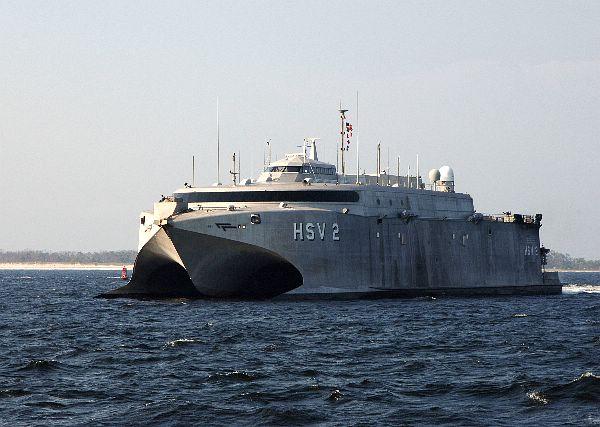 The U.S. Navy High Speed Vessel (HSV-2) Swift maneuvers through Pensacola Bay prior to arriving at Naval Air Station Pensacola, Florida to load and transfer relief supplies to the Gulf Coast region in support of Hurricane Katrina Relief efforts.
 The dock landing ship USS Tortuga (LSD 46) makes her way up the Mississippi River to the city of New Orleans to provide assistance in the relief efforts for the victims of Hurricane Katrina.
 A U.S. Navy SH-60 Seahawk helicopter takes off from the dock landing ship USS Tortuga (LSD 46) while it is moored pier side in New Orleans.
 A U.S. Navy Landing Craft, Air Cushion (LCAC), assigned to Assault Craft Unit Four (ACU-4), arrives on the beach in Biloxi, Miss., to offload relief supplies for the victims of Hurricane Katrina.

The new CNO of the Navy Adm. Mike Mullen is calling for the fleet to change the way it fights, in a speech before the Naval War College:
Mullen said that when he came into the Navy, it was all about "big ships and blue water, training for the big fight, training to fight the big bad 10-foot-tall Soviets." Today, however, "we face entirely new challenges, the likes of which we couldn't have even imagined just a few short years ago," CNO said.As 70 percent of the world's surface is covered by water, and more than 50 percent of the world's population lives within 16 miles of the shore, "without mastery of the sea - without sea power - we cannot protect trade, we cannot help those in peril, we cannot provide relief from natural disaster, and we cannot intercede when whole societies are torn asunder by slavery, weapons of mass destruction, drugs and piracy," Mullen stressed.
Sounds like Adm. Mullen is calling for smaller, less expensive warships, better suited for today's environement. Oh wait:
Mullen also stressed the need to build naval capabilities for littoral warfare."I want the ability to go close in and stay there," Mullen said. "I believe our Navy is missing a great opportunity to influence events by not having a riverine force. We're going to have one."
He also is calling for a "1000 ship navy", which sounds like a United Nations Fleet:
where ships of navies from around the world cooperate and operate routinely with one another.“We need to be a team player, a leader, for that 1,000-ship navy and a citizen in good standing for the city at sea,” he said.
Michael Hyatt, who works for a religious publishing company is donating 100,000 Bibles to victims of hurrican Katrina. At his blog he says:
Why Bibles? This afternoon, an official in Baton Rouge said on Fox News, “We need water, food, ... and Bibles.” This is something I knew we could help with.
If you want to participate in this program, make your check payable to “Samaritan's Purse” and send it to Jim Thomason. He will batch the checks together every few days and send them to Samaritan’s Purse with a matching check from Thomas Nelson.
What better gift can we give these people than hope? Thanks to James Taranto of Opinion Journal for this.
At this sight you can view an interactive satellite photo of New Orleans before and after the hurricane.
Those who say the struggle in Iraq is like the Vietnam War may be half right, says this article from the Washington Post:
the comparison to Vietnam may be instructive regarding another aspect -- the aftershocks of a premature American departure. Leaving Vietnam to the communists did not make anyone safer. The flight of the mid-1970s energized U.S. enemies in Iran, Cambodia, Afghanistan and Central America, while tearing our own country apart for nearly a quarter-century. Today, most Americans are indeed very troubled over the war in Iraq -- but mostly they are angry about not winning quickly, rather than resigned to losing amid recriminations.
We forget that once war breaks out, things usually get far worse before they get better. We should remember that 1943, after we had entered World War II, was a far bloodier year than 1938, when the world left Hitler alone. Similarly, 2005 may have brought more open violence in Iraq than was visible during Saddam's less publicized killings of 2002. So it is when extremists are confronted rather than appeased. But unlike the time before the invasion, when we patrolled Iraq's skies while Saddam butchered his own with impunity below, there is now a hopeful future for Iraq.
Today's era of instant information is now demanding instant results. . After FEMA and Homeland Security was too slow to respond, the Army and National Guard arrived to save the day, and few could argue with the outcome. Instant wars, instant disaster relief, there will be a price to pay , says the Washington Times:
The argument for the federal government in the future to fully take the lead is seductive after recent events have revealed legal arguments between federal, state and local officials causing delay confusion and, we dont doubt, avoidable deaths and misery. But with such advantages comes the obvious and traditional counter-arguments. If the federal government is to be in charge, then it would have to have authority to order evacuations before the fact, take control of state and local assets to affect such effort, such as roads, police, fire and infrastructure. (For example, Louisiana got its fair share of post-September 11 first-responder federal money. Under current law, how effectively they spent it was up too them, not the federal government.) In short, an efficient federal lead would require converting our sovereign states into administrative subdivisions of the national government.
Update-I agree with this!: Only one government bureaucracy functioned well under the stress of the Katrina crisis, (Rush)Limbaugh said: the U.S. military.

Call him "Rajun Cajun" or "John Wayne dude", General Rusel Honore is taking charge and overcoming redtape in Louisiana according to this from CNN:
The general came to rescue of one young mother trying to carry her twin babies down the street in the terrible heat and humidity of New Orleans, Starr reported. The mother was so exhausted the children were almost falling out of her arms.
The general went up to the woman and took both of her babies, handing them off to soldiers to carry, as he promised the mother that they were going to get her some help. The troops helped the three hurricane victims to a Coast Guard ship, where they were treated for exhaustion and dehydration.
Honore said he wants his troops' profile in New Orleans to be that of humanitarian relief operations, leaving the law enforcement role to the local police.
I'd like to nominate Gen Honore as commander of our troops in Iraq. Our forces there are doing a great job in every way except in PR. Nothing like a blunt talking character, like a Patton or a Schwarzkopf, to restore morale and strike fear into our enemies.

The US Navy's high-speed catamaran HSV Swift is speeding as only it can do, to the rescue of hurricane victims, as this story states:
A HIGH-speed catamaran built by Hobart shipbuilder Incat Australia is being used in the rescue and relief efforts in Louisiana in the wake of Hurricane Katrina.The 98m HSV Swift left the Incat shipyards in 2003 and is now operated by the US Navy as a fast supply vessel and troop transport.
It has seen service in the Middle East and South-East Asia after the Tsunami disaster and it is part of the military hurricane relief effort called Joint Task Force Katrina.
Swift has joined many vessels and aircraft of the US Air Force, Army, Navy and National Guard to rescue survivors, deliver supplies and repair communications infrastructure.
These sea-cats are quite capable vessels. About the size of a frigate, they can cruise into shallow waters, usually unaccessable to smaller vessels. Here's hoping the USN will purchase more of these!
While many are applauding the saving of major shipyards after the recent BRAC process, the question arises will we be able to afford enough ships to populate these bases. This is the dilemma the Navy's new chief is posing :
For the past year, the BRAC process has been a serious threat to the submarine base in Groton, but the new chief of naval operations points to a more long-term concern affecting the future of the installation: the high cost of modern ships and submarines.
Adm. Michael G. Mullen, speaking this week before an audience at the Naval War College in Newport, said that while he is committed to building the new Virginia class of submarines, he has to deal with the high expense of submarines and ships, including new classes of destroyers and aircraft carriers.
The Virginia's cost about $2 billion, the CVN-21 $10 billion and counting, and the DDX Destroyer another $3 billion. They way our budget is going, we may be able to afford one of each. Will this be enough to counter over 400 submarines deployed world wide, many to nations hostile to America?
Where are the troops? Most are right here according to National Review:
There are 1,012,000 soldiers on active duty, in the Reserves, or in the National Guard. Of them, 261,000 are deployed overseas in 120 countries. Iraq accounts for 103,000 soldiers, or 10.2 percent of the Army.
That’s all? Yes, 10.2 percent. That datum is significant in itself, a good one to keep handy the next time someone talks about how our forces are stretched too thin, our troops are at the breaking point, and so forth. If you add in Afghanistan (15,000) and the support troops in Kuwait (10,000) you still only have 12.6 percent.
So where are the rest? 751,000 (74.2 percent) are in the U.S. About half are active duty, and half Guard and Reserve. The Guard is the real issue of course — the Left wants you to believe that the country has been denuded of its citizen soldiers, and that Louisiana has suffered inordinately because Guardsmen and women who would have been available to be mobilized by the state to stop looting and aid in reconstruction are instead risking their lives in Iraq.
Here's a good article on the looting of New Orleans, I got from Powerline. The excusers have already started.
The final PC version of the story is likely to go like this: The desperate people left behind in New Orleans, nearly all black, had justification in brutally attacking their city because the help they frantically sought didn’t come.
In truth, the looters, rapists, and murderers who have terrorized New Orleans since Monday began their post-Katrina reign of terror a full day before the situation grew truly desperate—and it was their increasingly lawless behavior that kept willing but unarmed professional and volunteer rescue workers away from the city and from the poor people who needed saving.
and:
But while the looters have reportedly killed police offers and have shot at rescue workers, they’re mainly victimizing, as usual, other poor blacks. The vicious looters aren’t the face of New Orleans’ poor blacks. Their victims are: the thousands of New Orleanians who made their way to shelter before the storm, and who rescued others and brought them to shelter during and after the storm—but who now cannot get the help they desperately need.
I guess some people think the best way to solve a problem, is to deny their is one. Isn't this what many muslims are doing about terrorism? Close your eyes and blame Bush.

The Hospital Ship Mercy is not going to Caribbean to support the Hurricane relief efforts as this from Northern Command states:
Update• The USNS Mercy remains in port in San Diego. An earlier news release indicated the ship would sail for the Gulf Coast to participate in humanitarian operations there. Naval forces already in the area or en route have enough capacity to meet current projected operational needs. Should requirements change, the Mercy and other assets remain available to join the operation.
We've heard a lot about the troop shift in Korea, so I guess its official now. As this NYT article states, the US military will rely more on swift intervention forces, and long-range bombers to protect the divided peninsular:
American commanders are making significant changes in their plans in the event of a military conflict with North Korea, to rely in large measure on a new generation of sensors, smart bombs and high-speed transport ships to deter and, if necessary, counter that unpredictable dictatorship, the senior United States commander in South Korea says.
The shift in strategy is being undertaken even as the United States cuts the number of troops here by one-third and begins moving the remaining soldiers farther from the demilitarized zone, to improve their chances of surviving any North Korean offensive.
Army headquarters in Washington has made a formal announcement that a brigade of Second Infantry Division soldiers sent urgently from South Korea to Iraq last year will not return to South Korea, but will instead return to a base in the United States. That puts the American troop commitment to South Korea on track to drop from 37,500 - a figure maintained since the early 1990's - to 25,000 by 2008.
I agree sith this. High speed transport and bombers to hold the Pacufic, major troop concentration in the Middle East, air bases and maybe a brigade in Europe, and surge forces in reserve at home.
A bold plan from Canada, whose new defense chief wants new military aircraft ASAP. The Canucks are worse at replacing worn out equipment than we are than we are, and General Rick Hiller wants to fix this, as this article states:
The plan is to ram a deal favouring mainly American companies -- no other bidders need apply -- through cabinet before Christmas.
Makes sense, say the boys at the Defence Department. The new planes -- heavy-lift helicopters, search and rescue aircraft, and cargo vehicles -- are badly needed to replace our creaking craft, especially when we've got grunts in Afghanistan who are vulnerable without the right stuff. The planes they're using now are three and four decades old.
Go the usual procurement route, supporters of the proposal say, and you wait for almost a generation. Indeed, the Defence Department did a study a while back. Average time for a military purchase from the concept stage to actual acquisition? Seventeen years! Enter Redneck Rick, the blunt Newfoundlander with a bolder military vision than peacekeeping. "We are the Canadian Forces," he said, "and our job is to be able to kill people."
This funny story from Britain has the Army worried about it's Challnger tanks to new EU rules. The article explains:
Defence chiefs are fighting to prevent the Army's tanks being stopped in their tracks by the introduction of a European directive on vibration and noise at work.
The Control of Vibration at Work Regulations and the Control of Noise at Work Regulations have left officers scrambling to discover if the military's armoured vehicles break the rules.
But with a slim chance of reducing vibrations in a Challenger 2 tank and the Warrior armoured vehicles, the Ministry of Defence will be seeking an exemption from the rules by invoking an "opt-out" clause. Soldiers who travel in the back of tanks and are subjected to substantial jolts and constant noise will have to suffer the discomforts until at least 2010 when the regulations become law.
As the Huey helicopter came to signify the Vietnam War, the Conflict in Iraq will be remembered for the Stryker. Rushed into service and initially derided by vets, the vehicle has become much loved by the troops. This article describes why:
The vehicle, built by Sterling Heights, Mich.-based General Dynamics Land Systems, was named for two Medal of Honor recipients: WWII Pfc. Stuart Stryker and Spc. Robert Stryker, who served in Vietnam.
It boasts a digitized sensor suite that gives it much better access to intelligence information than older combat vehicles. A newly added steel cage looks ungainly - the Stryker is much wider on top than its wheel base -- but grenades bounce off before they explode.
Most importantly, it is proving to be very protective of the people it carries inside. According to the brigade`s statistics, as of June, Strykers had been involved in nearly 700 direct engagements with the enemy -- among them IEDs, car bombs, and rocket-propelled grenade attacks. There have been around 250 injuries, but just over 200 of the injured returned to duty within three days, like Robinson.
There have been just four killed in Strykers.
As of yesterday here are is the military response for the Hurricane Katrina disaster:
• Defense Coordinating Officers and Defense Coordinating Elements, known as DCEs, are on site in Clanton, Ala., Baton Rouge, La., and Jackson, Miss., to liaison between U.S. Northern Command, FEMA and the Department of Defense.
• Maxwell Air Force Base, Ala., Naval Air Station Meridian, Miss., Barksdale Air Force Base, La., Alexandria, La., and Ft. Polk, La., have been designated as federal operational staging areas to expedite the movement of relief supplies and emergency personnel to affected areas.
• U.S. Transportation Command is flying 8 swift water rescue teams from Calfornia to Lafayette, La. These California-based teams provide about 14 personnel with vehicles and small rigid hulled boats who are highly trained and capable of rescuing stranded citizens from flooded areas.
• The hospital ship, USNS Comfort, is departing Baltimore to bring its medical assistance to the Gulf region. The Comfort should reach the area in seven days, officials said.
• Three Army helicopters from III Corps at Fort Hood, Texas, are in Baton Rouge and two more in Mississippi to assist with search and rescue and damage assessment.
• USNORTHCOM established Joint Task Force Katrina to be the military’s on-scene commander in support of FEMA. Lt. Gen. Russel Honoré, commander of First Army at Fort Gillem, Ga., is the JTF commander. JTF-Katrina will be based out of Camp Shelby, Miss.
• JTF-Civil Support is providing a joint planning augmentation cell.
• U.S. Northern Command’s Joint Operations Center is on 24-hour duty in Colorado Springs, Colo., to facilitate any additional requests for assistance that may come from FEMA representatives.
This was a comment by a spokesman for the Multinational Force in Iraq, describing the insurgents, after some sad news form the Tigris river. Read this:
The Iraqi air force used three C-130 Hercules aircraft to reposition Iraqi security forces to the western Ninewa province Aug. 28 and 29, Army Maj. Gen. Rick Lynch, a Multinational Force Iraq spokesman, told reporters at a news briefing. This was the first time Iraqi air assets have been used to directly support the deployment of Iraqi combat forces inside the country, Lynch said, and is a testament to the progress of Iraqi forces.
"It was a magnificent mission on the part of truly trained professionals," he said.
The quick response of Iraqi forces to the Aug. 31 accident on a bridge over the Tigris River in Baghdad was also was evidence of their progress, Lynch said. Iraqi police immediately sealed off the area to prevent attacks, and Iraqi security forces, police and medical professionals provided care to the injured, he said.
"Their heroic and professional actions in the face of devastating tragedy reflected a concern for their fellow citizens, acting out of compassion in a time of need and a time of great urgency," he said.

 Posts
All Comments
Posts
All Comments


